
Hawaiian bird archive · Native waterbirds
Hawaiian Coot
Fulica alai · ʻAlae keʻokeʻo
A pale shield rises from the bill onto the forehead of this charcoal-colored swimmer. On an Oahu pond, it is often the first detail that separates a Hawaiian Coot from the gallinule sharing the same water.
View the photographs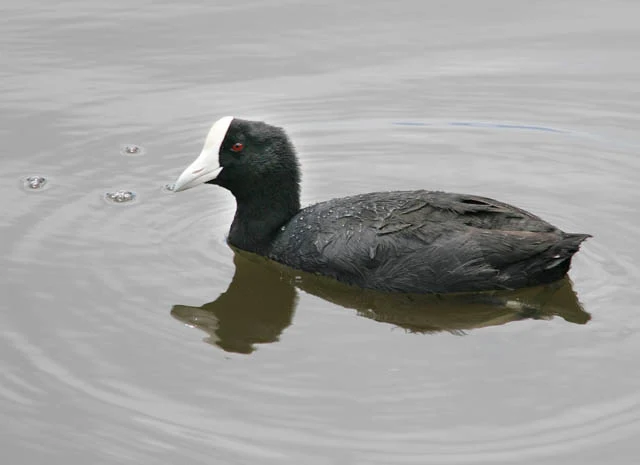
- Scientific name
- Fulica alai
- Family
- Rallidae
- Habitat
- Fresh and brackish wetlands
- Archive photographs
- 1
Look at the feet
A coot paddles with a separate scalloped lobe along each toe. When a bird steps onto a muddy bank, those broad toes are much easier to see than they are on a swimming bird.
Across the pond
Start with open water, then scan the edges of flooded fields, aquaculture ponds and marshes. Coots may gather in groups. A bird diving for food can disappear altogether while others carry on picking at vegetation at the surface.
Two native rails
Both the coot and gallinule have dark bodies and a shield on the forehead. The coot usually shows white across bill and shield. The adult gallinule combines a bright red shield with a yellow bill tip and a narrow white stripe along its flank.
Oahu Nature Tours photographic archive
1 photograph of the Hawaiian Coot
Photographic series
Photography by Michael Walther · © Michael Walther. All rights reserved.